Random thoughts and questions on Igbo traditional weddings, 1 and 2

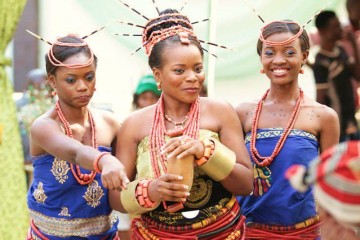
Random thoughts on Igbo traditional weddings (1) 

 How much more married can a person be, after 2 families and their friends have come together and shared a meal and drank over it, after two families have broken bread in agreement and given their children away to each other ? 

 I realize with the advent of missionaries and the gospel of Christ, certain aspects of Igbo tradition and culture had to be done away with. However, do we throw out the baby with the bath water? How is it that the closest to Hebrew marriage found in the bible has been relegated to second place in favour of a church wedding ( with all its attendant processes) ? These days young couples and their families bear the burden of paying for several weddings. I realize that there is a place for “church” but must it be as it is now? 


Some people feel that they are not married until they have had their “church wedding” , in spite of the fact that they have gone through the traditional process that is required and acknowledged by their culture. Where is the place of the black tuxedo or tail coat for and Igbo man?

Random thoughts on Igbo traditional weddings (2) : Quantum of Bride Price 

So I was speaking with my cousin who I hadn’t seen in a while and I asked what was going on with her and her husband to be, specifically about how far they had gone with regards to their wedding arrangements and she said in a tired voice “ We are making progress, they told us to bring fifty thousand naira before they give us the list. “ I was like “What ????!!!!!????” 😮 First time I had ever heard of a “pre wedding list “ fee. It seems Igbo traditional weddings are becoming even more expensive. 

My question is “Why?” 

 Some people will lay claim to tradition, others will talk about increased economic pressure in today’s world. My opinion is that old men, so called custodians of Igbo tradition have made a decision that is purely selfish in nature, to twist tradition and culture for personal gain. They have no concern for the financial strain their “decrees” have on grooms ( who are mostly young men who are not totally settled financially). Why is this allowed? Is this avarice all part of being Igbo? 

 This issue of exorbitant bride price and other related matters isn’t new. Apparently, in the old Eastern region of Nigeria, a law existed limiting the bride price to a certain amount ( Limitation of Dewey Law 1956, section 3(a))  from http://www.onlinenigeria.com/marriage/brideprice

Is greed and avarice ingrained in the Igbo psyche? Or is it a horrible stereotype that we have embraced?? Is a lorry load of yams  (amongst many other things) not excessive? A carton of skin pomade and powder, is that to start up a little shop or what??? 

Things need to change and I realize that it starts with the individual. It’s a long and hard road but it is possible.



Gender ruminations

Gender ruminations, Africa, Nigeria, Igbo.

Thinking about the highly patriarchal society that is Africa, Nigeria and Igbo land that I grew up in, that I call home, it is not news that women and children are subjugated in that environment. I’ve jut been cogitating on the implications for that space.

I turn 37 this year, I’ve been emotionally and physically involved with African men and men of African descent. My gender cogitations intensified as a result of my varied interactions with them. I find that majority of them , within and without the Body of Christ, have been ( have tried to be is more accurate because they did not succeed) harmful, not physically, but emotionally. As I have grown older in years and more comfortable in my own skin, I noticed that the psychic violence increased, sometimes quite subtle and sometimes very overt.

I have interacted with men from many different cultures as a result of my meanderings on the earth and made a well thought out decision that when it came to choosing a life partner, I would always go with “my people” ( for various reasons which I won’t go into here). This choice has led me into a great forest of thorns.

For all the personal inner growth I have experienced by the grace and mercy of God, hard work, self-sacrifice and self-denial, plain old seppuku/harakiri, MY AFRICAN BROTHERS DON’T APPRECIATE MY STRONG SENSE OF SELF. Because they haven’t done the work on their own selves, even though they recognize the worth of the woman I am becoming, my brothers have rejected, wounded and worked hard to belittle me in order to have CONTROL over my life force and strength of purpose, to be used for their own ends : my feminine power is a means/commodity to their own ends. This I refuse and resist most vehemently.

It has cost me too much to be where I am , who I am today.

From these cogitations I have come to the conclusion ( quite obvious really, not ground breaking , this) that Africa, Nigeria, Igbo is the way it is because the male power is extreme in its decision to subdue, subjugate and dis-empower feminine power to co-function with it in the totality of life in that location.

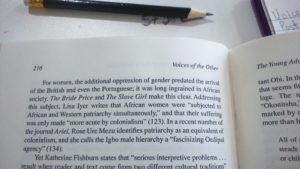
Reading from “Voices of the Other” – “For women, the additional oppression of gender predated the arrival of the British and even the Portuguese: it was long ingrained in African society. … Addressing this subject , Lisa Iyer writes that African women were “subjected to African and Western patriarchy simultaneously “ and that their suffering was only made “more acute by colonization.” “

In a recent number of the ARIEL, Rose Ure Mezu identifies patriarchy as an equivalent of colonialism and she calls the Igbo male hierarchy a “fascisizing Oedipal agency”( page 216).”

This quote and its contents lead in excellently into my next thread of thought that is related to an angle of this matter that I have been pondering: Biafran women and their largely overlooked role during the ghastly genocide (physical, cultural, emotional) inflicted on Igbo people and their sympathetic and unsympathetic neighbours under the all acceptable all covering label of “war”. This “war” was inflicted upon them and their children by Ojukwu and his friends, enemies and frenemies. They did not ask for it nor want it, they were not consulted and did not constitute or contribute to any part of the decision making process.

Extreme patriarchy exists in Africa, kept alive and functioning by the patriarchal men and women born of that environment.

This was handwritten in one of my journals in 2016.